


Blog

  • Peach Baked Oatmeal | Kara Lydon

    Peach Baked Oatmeal | Kara Lydon

    This nourishing and cozy peach baked oatmeal is easy to make ahead of time and reheat throughout the week! Baked with fresh peaches and warming spices, this breakfast is perfect for summer or fall!
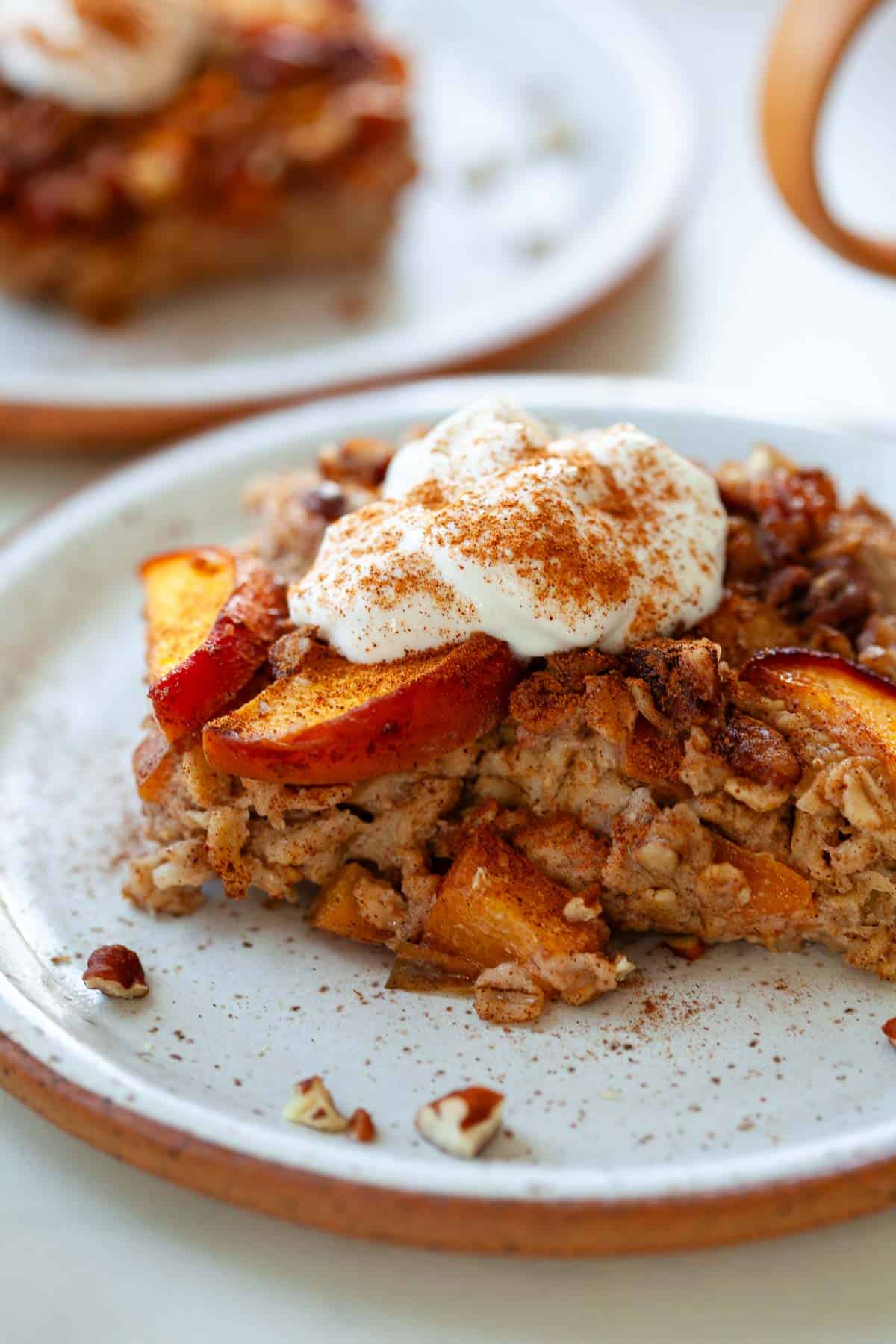
    peach baked oatmeal with dollop of yogurt and sprinkled cinnamon on white speckled plate

    Why I Love This Recipe

    This Peach Baked Oatmeal is a warm, hearty breakfast that is perfect when you’re craving something cozy and comforting in the morning. 

    Baked oatmeal is one of my favorite breakfasts because it is satiating, delicious, and so easy to make. It has a hearty texture that almost reminds me of bread pudding and is filled with warm, cozy spices like cinnamon and nutmeg. 

    The best part is it requires only 5 minutes of prep time and 45-50 minutes in the oven and you’re left with breakfast for the week. I love make-ahead breakfasts because they takes the guess-work out of what to eat in the morning and only involve one clean up. I’m all about less mess!

    You can also freeze baked oatmeal to make sure none of the leftovers ever go to waste!

    This baked oatmeal calls for fresh peaches which are in season right now, but the recipe is totally adaptable to whatever fresh (or frozen or canned!) fruit you have on hand. It can also be tweaked based on your flavor preferences or what season we’re in.

    Check out my Apple Baked Oatmeal and Gingerbread Baked Oatmeal for some inspiration on other variations.  

    Ingredients You’ll Need
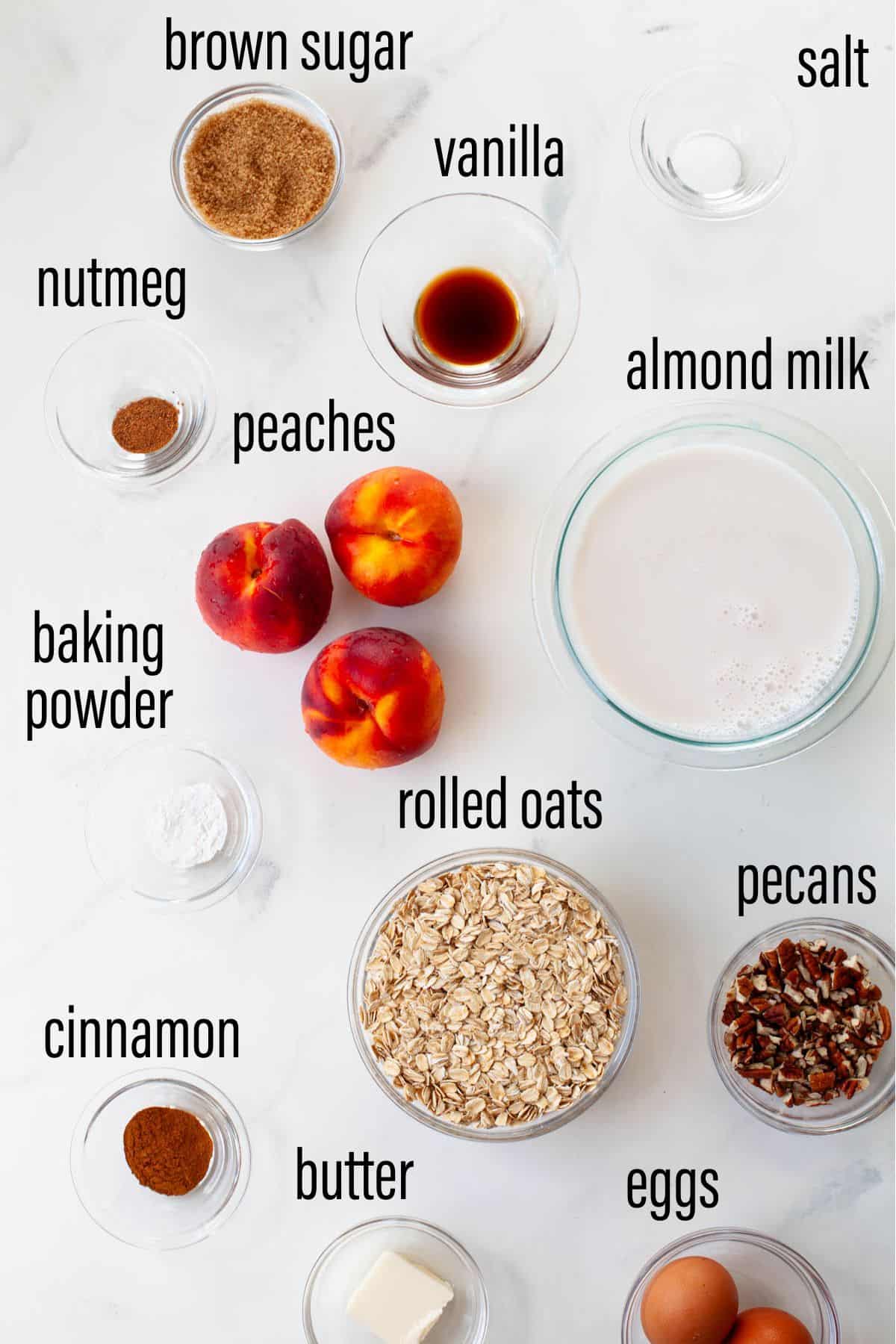
    graphic of ingredients for peach baked oatmeal on marble surface with black text overlay

    Notes on Ingredients

    peaches: I love making this with fresh peaches during the summer months when it’s available but frozen or canned/jarred peaches would work well for year-round. 

    rolled oats: I like using old-fashioned rolled oats vs. quick oats since they’re larger and retain their texture better with baking. If you want to make a gluten-free version, be sure to grab gluten-free rolled oats. 

    eggs: act to bind the ingredients together

    brown sugar: helps to caramelize the peaches and provide some sweetness. You can substitute with coconut sugar or maple syrup depending on what you have on hand.

    vanilla: for sweetness! 

    butter: acts as a flavor enhancer 

    unsweetened almond milk: I like using almond milk for it’s mild, neutral taste but feel free substitute with cow’s milk or your favorite non-dairy milk alternative.

    cinnamon: adds a warm, cozy flavor 

    nutmeg: provides a nutty, warm and slightly sweet flavor

    salt: enhances the flavor 

    baking powder: helps the oats rise in the oven 

    pecans: completely optional but adds a satisfying crunch and texture 

    Equipment You’ll Need (affiliate links – if you make a purchase I receive a small commission):

    Mixing Bowl

    Baking Dish

    How to Make Peach Baked Oatmeal
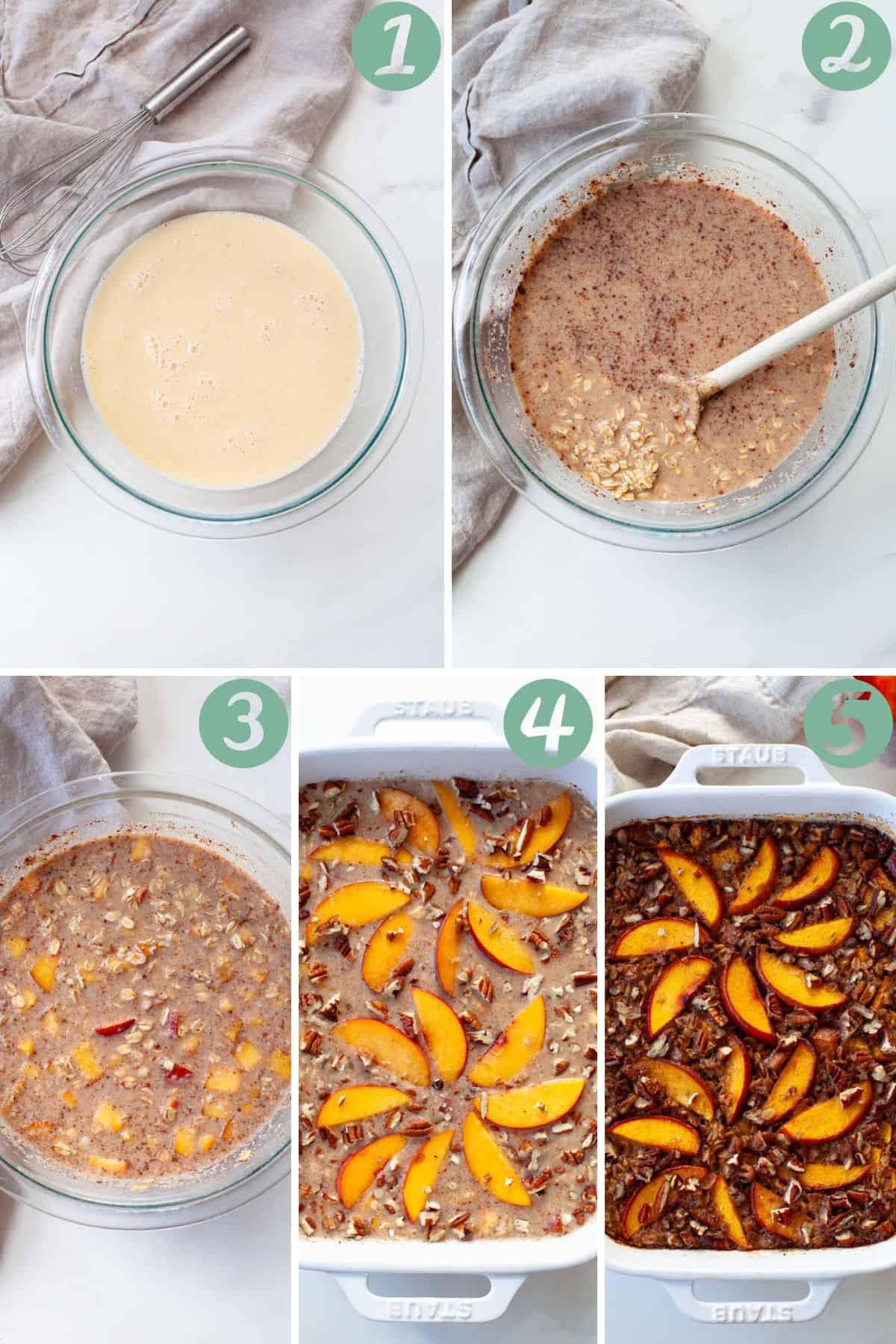
    step by step graphic of how to make peach baked oatmeal

    Combine wet ingredients. Whisk eggs, brown sugar, vanilla, melted butter, and almond milk in a large bowl until combined.
    Add dry ingredients. Add rolled oats, cinnamon, nutmeg, baking powder, and salt, and stir to combine.
    Add peaches. Fold in chopped peaches. 
    Pour the mixture. Pour mixture into a 9-in square or 11×7 baking dish. Top with pecans, if desired. 
    Bake and serve. Bake until the center of the oatmeal is set, about 45-50 minutes. Let cool on a wire rack for at least 10-15 minutes. Serve hot or cold! 

    Expert Tips

    Make this a make-ahead breakfast! Mixture can be made ahead of time (like on a Sunday!) and stored overnight in the fridge. Let sit out at room temperature while the oven preheats and stir mixture before baking. Bake in the morning and you’ve got breakfast for the entire week! 

    Recipe FAQs

    Are baked oats healthy for you? 

    They sure are! Oats are a nutritious whole-grain that are rich in many vitamins and minerals including manganese, phosphorous, copper, B vitamins, iron, selenium, magnesium, and zinc. They are high in soluble fiber and have been linked to many health benefits like lowering cholesterol, reducing the risk of hypertension, diabetes, and cardiovascular disease, and promoting a healthy gastrointestinal tract. 

    What’s the difference between baked oats and overnight oats?

    Baked oats are like a fluffy, breakfast casserole that makes for a great meal-prep breakfast. Baked oatmeal is made by mixing oats with a liquid (usually milk or water), a sweetener (maple syrup, honey, brown sugar, etc.), eggs, and any additional ingredients for variety and flavor. They typically go straight from a mixing bowl to a baking dish and into the oven while overnight oats rest in the fridge overnight and are not cooked. Overnight oats tend to be more creamy and baked oatmeal is more set. 

    Can I use frozen peaches instead of fresh?

    Frozen peaches can be used instead of fresh, just be sure to thaw them and drain them beforehand. Baking times may vary where the use of frozen peaches may require an extra few minutes in the oven.
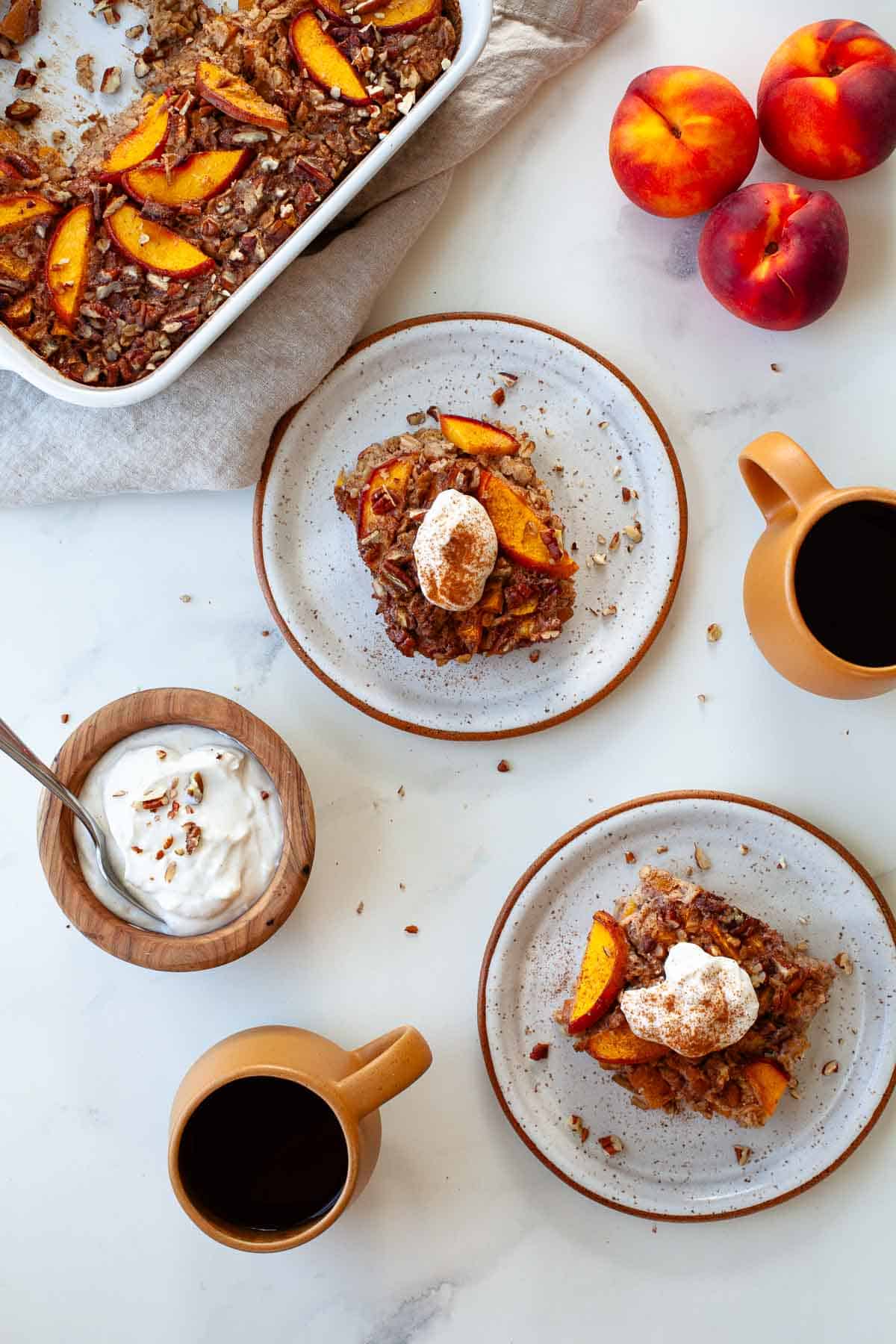
    two white speckled plates with peach baked oatmeal beside two orange coffee mugs, a wooden bowl filled with yogurt, peaches, and a baking dish with peach baked oatmeal

    Storage and Preparation

    Peach Baked Oatmeal leftovers can be stored in an airtight container in the refrigerator for up to 4 days. Reheat in microwave for 1 minute with a little splash of almond milk or milk.

    Baked oatmeal is also freezer-friendly. To store in the freezer, bake as directed, let cool completely, then store in an airtight container in the freezer for up to 3 months.

    Recipes That Pair Well

    Veggie Egg Bites

    Cozy Lavender Almondmilk Latte

    Air Fryer Eggs 

    Strawberry Rhubarb Pie Smoothie

    Pomegranate Smoothie
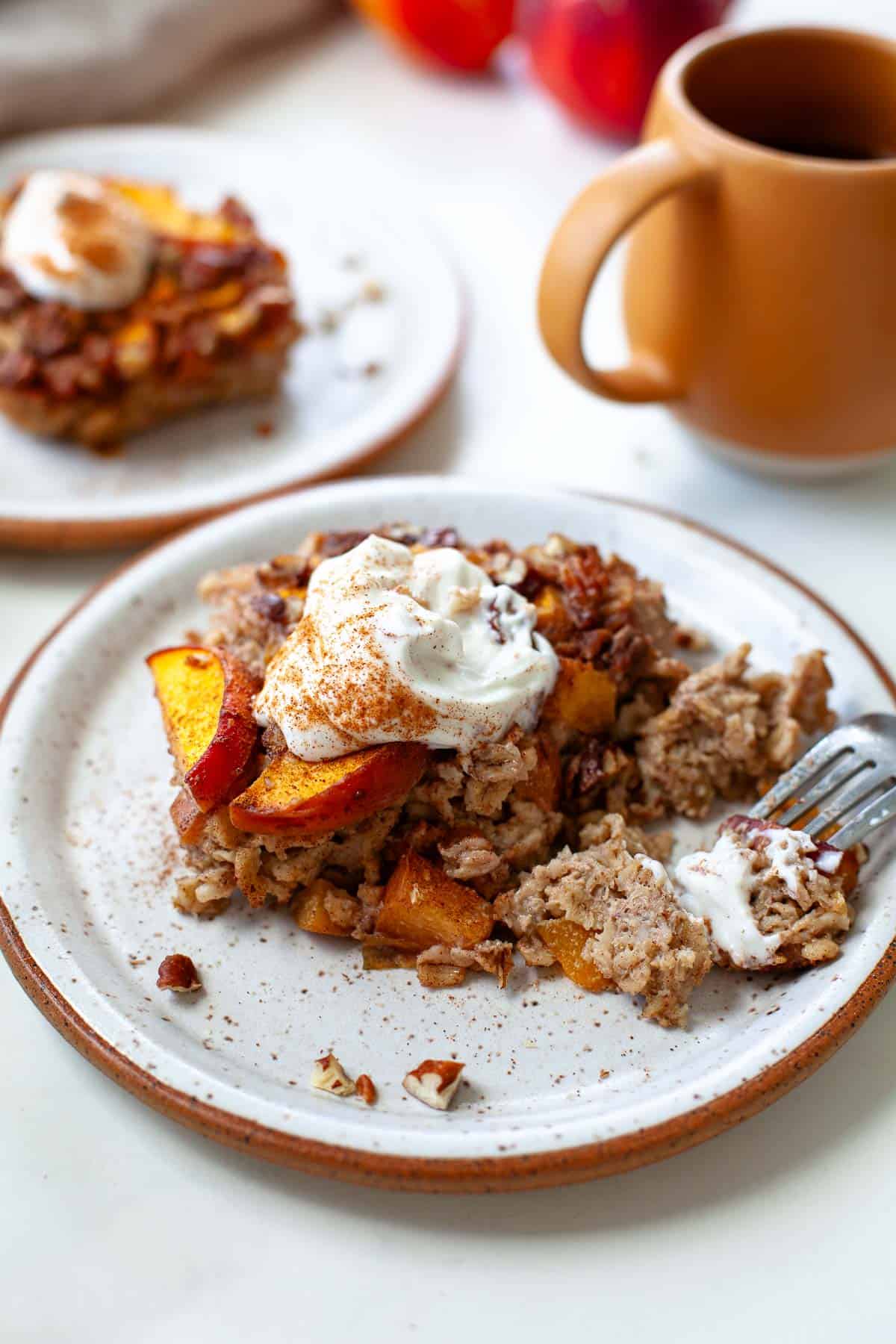
    two peach baked oatmeal on white speckled plates topped with yogurt and cinnamon

    For more oatmeal inspiration, check out my other recipes below! 

    Apple Baked Oatmeal

    Gingerbread Baked Oatmeal

    Banana Bread Oatmeal

    Mango Overnight Oats

    Roasted Blood Orange Oatmeal

    If you like this recipe, please be sure to comment and give it a 5 star rating below. If you make it, share it on Instagram and tag me @karalydonrd and I’ll re-share it with my followers! If you want to save this recipe for later, be sure to pin it on Pinterest!

    Don’t miss a recipe! Sign up to receive my monthly newsletter with a round-up of recipes from the previous month and get my FREE guide when you sign up: Rediscover the Joy in Eating: 5 Simple Steps to Stop Stressing Over Food + Enjoy Every Bite.

    Print

    clock clock iconcutlery cutlery iconflag flag iconfolder folder iconinstagram instagram iconpinterest pinterest iconfacebook facebook iconprint print iconsquares squares iconheart heart iconheart solid heart solid icon

    Description

    This nourishing and cozy peach baked oatmeal is easy to make ahead of time and reheat throughout the week! Baked with fresh peaches and warming spices, this breakfast is perfect for summer or fall!

    2 eggs
    1/3 cup brown sugar
    2 teaspoons vanilla
    2 tablespoons butter, melted
    2 1/2 cups unsweetened almond milk
    2 cups rolled oats
    1 teaspoon baking powder
    2 teaspoons cinnamon
    1/2 teaspoon nutmeg
    1/2 teaspoon salt
    3 peaches, chopped and sliced (1 1/2 cup chopped and 1/2 cup sliced)
    Optional: 1/2 cup chopped toasted pecans

    Preheat oven to 375 degrees F.
    In a large bowl, whisk eggs, brown sugar, vanilla, butter, and almond milk until combined.
    Add rolled oats, baking powder, cinnamon, nutmeg and salt, and stir to combine.
    Fold in chopped peaches.
    Pour mixture into a 9-in square or 11×7 baking dish. Top with pecans, if desired.
    Bake until oatmeal is center is set, about 45-50 minutes.
    Let cool on wire rack for at least 10-15 minutes. Serve hot or cold!

    Notes

    Leftovers will keep in the refrigerator for up to 5 days. Reheat in microwave for 1 minute with a little splash of almond milk.
    Mixture can be made ahead of time and stored overnight in the fridge. Let sit out at room temperature while the oven preheats and stir mixture before baking.

    Prep Time: 10 minutesCook Time: 45 minutesCategory: BreakfastMethod: Baking

    Keywords: peach baked oatmeal, baked peach oatmeal, baked oatmeal with peaches

  • Egg Roll In A Bowl (Healthy and Easy)

    Egg Roll In A Bowl (Healthy and Easy)

    Egg Roll In A Bowl (Healthy and Easy) – The Real Food Dietitians


    Verified by MonsterInsights

  • Acids And Enzymes: Gentle Exfoliation For Sensitive Skin

    Acids And Enzymes: Gentle Exfoliation For Sensitive Skin

    Exfoliating is the secret weapon of skin care. It might already be a part of your routine, but did you know that it’s the go-to for glowing skin? Its function is to get rid of dead cells that can accumulate on the surface of the skin and cause the complexion to look dull. This makes exfoliation a great step to focus on if you want to reveal soft, luminous and even skin. Exfoliation can be broken down into chemical and physical – but even within those categories, there are subcategories. Enzymes and acids make up a group of gentler chemical exfoliants, perfect for all skin types including sensitive skin. Ready for a lesson? Let’s break it down.

    What Is Exfoliation? 

    A quick refresher: Exfoliation is the process of removing those dead skin cells from the surface of your skin using a safe chemical, a granular substance or an exfoliation tool. While we usually discuss exfoliation in relation to skin on the face, it can actually be performed on almost all of the skin on the body — from dry elbows to scaly legs and cracked heels. When that layer of dead skin is gone, the skin underneath looks polished and brighter (since dead skin = dullness). The fresh, glowy skin is then better prepared to evenly absorb any products that are applied afterwards, including moisturizers, serums and self-tanners.

    What Are Acids?

    If you’re already quite savvy with your product knowledge, you’re probably familiar with some skin care “acids.” There are different types of acids used for exfoliation and their level of intensity varies. The big three are AHAs, BHAs and PHAs, all of which are exfoliating ingredients that work by breaking down the bonds that keep dead skin cells clinging to the skin’s surface. By breaking down these bonds, acids can bring out new, fresher-looking skin. Each type has its own unique benefits: AHAs are water soluble and target dullness, dehydration and signs of aging. BHAs are oil soluble, penetrate deeper into the skin and balance oils (a savior for breakout-prone skin). PHAs are gentle and non-irritating, so they’re suitable for sensitive skin. 

    What Are Enzymes?

    Enzymes help accelerate chemical processes. You’ve probably heard of enzymes in the context of digestion. They are proteins (usually made in the body) that help break food down into smaller parts so your body can easily digest the nutrients. When it comes to enzymes on the skin, their role is to break down keratin – aka the protein in dead skin cells that makes them stick together on the surface. In that sense, enzymes are similar to acids, but they often feel gentler and less intense on the skin. These tiny molecules (often harvested from fruit like pineapple, pumpkin, cherries and papaya) help to dissolve old fibers in the skin to make way for new ones to be synthesized. Without enzyme activity, you would see a buildup of dead cells and old fibers to the skin. 

    So what sets enzymes apart from acids? Enzymes get rid of those dead skin cells at the surface of the skin, but they don’t promote cell turnover for living cells underneath. Think of enzymes as shedding skin that’s already dead, rather than letting it sit on the surface and cause dullness. They exfoliate and brighten the complexion, are generally recommended for use about every 2-3 days and are safe to use while pregnant, though we always recommend speaking to your doctor. 

    Acids, on the other hand, penetrate deeper into the skin and accelerate turnover for all of your skin cells, not just the ones hanging out up top. Acids physically turn over the cells which can cause shedding of the skin and allow new skin cells to generate.

    So how do you know which type of exfoliant is better for you? Because enzymes don’t penetrate as deeply into the pores, they tend to be less abrasive on the skin. If you have sensitive skin, then sticking to an enzyme-based exfoliant might be the answer. 

    Acids can work for various skin types, but you may have to play around to figure out which ones are the best option based on your skin concerns and goals. The forced cell turnover that some acids provide can be game-changing for hyperpigmentation, sun damage and acne.

    Acids and Enzymes From Eminence Organics

    The Yam & Pumpkin Enzyme Peel 5% contains pumpkin, pineapple and papaya enzymes, as well as lactic and glycolic acids. This enzyme peel accelerates the exfoliation process, removes dead skin cells and reduces the appearance of dark spots, fine lines and sun damage. A delicious purée of yam and pumpkin, this exfoliant leaves the skin looking firm and radiant. 

    The Arctic Berry Peel & Peptide Illuminating System is another option formulated with both enzymes and acids. This innovative 3-step peel and peptide system is designed to exfoliate and keep skin radiant in between spa treatments. The at-home system is a favorite, with 5-star reviews across the board. One customer, Trina, calls the set “amazing,” continuing in her website review: “Words cannot describe the huge difference in my skin. I have never experienced a more effective at-home product!!!!” Another fan, Abbie, says “My skin looks bright, tight, and my pores are significantly smaller – even my husband noticed. I’m buying it for both my husband and me to use,” and Stacy says “You Need This!” and is even sharing it with friends: “I could not be happier. About a day after using the product, your skin will be glowing. I love it so much, I’ve been giving it to others as gifts.” 

    If you’re looking for a toner with enzyme and acid ingredients, our Pineapple Refining Tonique uses both bromelain, a gentle-yet-effective enzyme exfoliant derived from the fruit and stem of the pineapple plant, and polyhydroxy acid (PHA), a mild exfoliant that noticeably renews the feel of the skin while targeting dryness and the visible signs of aging. The combination of both enzymes and acid helps brighten the look of the skin, minimizes the appearance of dark spots, unclogs pores and hydrates the skin.

    Are you interested in adding enzymes into your exfoliation routine? Visit your nearest Eminence Organics Spa Partner to find out which ones are right for you.

  • Oatmeal Breakfast Bars with Wild Blueberries

    Oatmeal Breakfast Bars with Wild Blueberries

    Oatmeal Breakfast Bars with Wild Blueberries – The Real Food Dietitians


    Verified by MonsterInsights

  • Salmon Burgers (Easy and Healthy)

    Salmon Burgers (Easy and Healthy)

    Salmon Burgers (Easy and Healthy) – The Real Food Dietitians


    Verified by MonsterInsights

  • 16 Healthy Snacks Anyone Can Make

    16 Healthy Snacks Anyone Can Make

    16 Healthy Snacks Anyone Can Make – The Real Food Dietitians


    Verified by MonsterInsights

  • Bakuchiol: What Is This Retinol Alternative?

    Bakuchiol: What Is This Retinol Alternative?

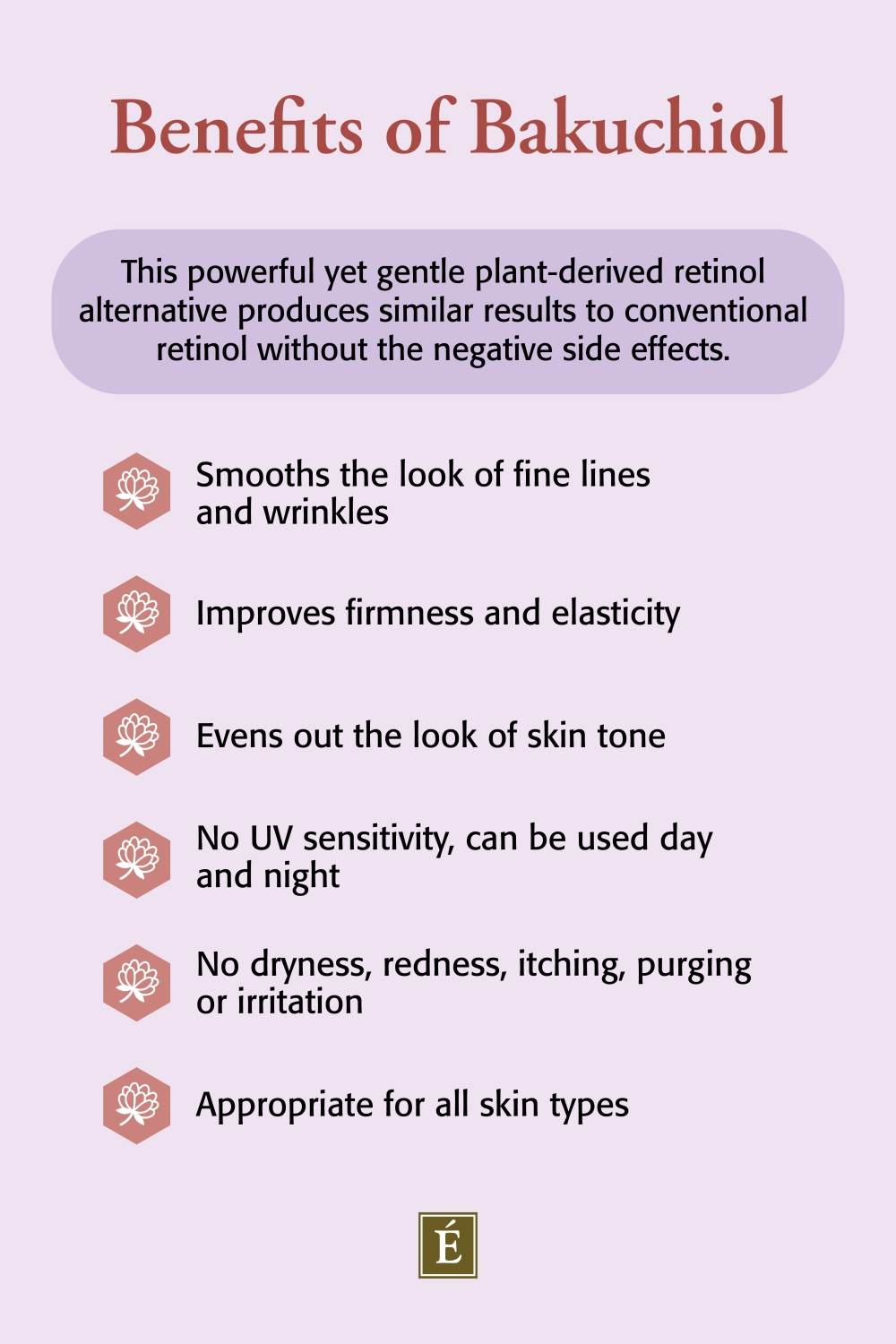
    You may have heard the social media buzz around bakuchiol, with lots of (tik) talk about this ingredient among skin care enthusiasts. So why is it getting so much hype? Touted as a natural retinol alternative, this plant-based powerhouse offers many of the same skin benefits as conventional retinol, minus the harsh side effects. Let’s peel back the layers and explore what is bakuchiol, what skin care products feature this botanical extract and its long list of skin care benefits.

    Benefits Of Bakuchiol 

    What Is Bakuchiol?

    Bakuchiol is an extract derived from the leaves and seeds of the babchi plant. Though it’s relatively new to the beauty world, the herb has been used in Indian Ayurvedic and Chinese medicines for hundreds of years. Traditionally, this potent little plant has been used to help heal, calm and soothe the skin, thanks to its anti-inflammatory and antibacterial properties. 

    Bakuchiol has been touted as an effective and natural alternative to conventional retinol. While the two are different in numerous ways, including at a molecular level, many of their benefits are similar. Yet what sets them apart is what makes bakuchiol the new darling of the skin care world. 

    Conventional Retinol is known as an ingredient that multitasks to help your skin look its best. It increases skin cell production, helps unclog pores, exfoliates skin and increases collagen production, which can reduce the appearance of fine lines and wrinkles, giving your complexion a fresher, plump appearance. Sounds too good to be true, doesn’t it? Well, for some, it is. Retinol can cause increased irritation, excessive dryness, peeling, itchiness and enhanced sun sensitivity. 

    Enter: Bakuchiol. This plant-based powerhouse offers many of the same results as retinol without the harsh side effects or concerns. In other words, all of the upside with none of the down. It can reduce the appearance of fine lines and wrinkles, help restore firmness, refine skin texture and even out skin tone in a gentle yet effective way. 

    Benefits of Bakuchiol

    You keep hearing about it and we’re here to tell you that the hype is real. Let’s explore this ingredient a little further and find out why it’s having such a moment in the skin care world. 

    Doesn’t Irritate

    One of the many things that retinol users find irritating is, quite literally, irritation. Peeling, redness and sensitivity are often associated with a topical retinoid. While these unpleasant side effects usually subside after a few days or weeks (as your skin gets used to the ingredient), those with sensitive skin can find the process too uncomfortable to endure. And this is assuming the retinol concentration is appropriate for your skin – even at a low level, like 0.25%, the peeling and redness can be at a 10. This is a conversation for your dermatologist if you want to go that route, but bakuchiol products are another option worth exploring. Bakuchiol is well tolerated by most skin types, including sensitive, and can be used day and night (conventional retinol should only come out after dark) because it doesn’t cause sun sensitivity, which is a major bonus.

    Smooths The Look Of Fine Lines And Wrinkles

    Is there anyone who doesn’t want their skin to look and feel smoother? Clinical studies have demonstrated bakuchiol’s potential in minimizing the appearance of fine lines and wrinkles. Its ability to enhance cell turnover results in smoother and more even-toned skin by boosting elasticity and firmness. Incorporating bakuchiol into your skin care routine can help you achieve a youthful-looking and rejuvenated complexion. Sign us up!

    Improves Firmness And Elasticity

    As skin ages, it’s common for its elasticity (aka, its ability to stretch and bounce back) to decrease in tandem with its firmness (turkey neck, we’re looking at you). This loss of elasticity can be caused by a reduced production of natural oils, oxidative stress from sun exposure, pollution and good old gravity. Studies have shown that much like conventional retinol, bakuchiol can improve firmness and elasticity in the skin. Bakuchiol slows the breakdown of collagen and increases elasticity, giving you skin that looks firmer and plumper and tighter.

    Evens Out Skin Tone 

    Uneven skin tone can show up in a number of ways. When your skin has some type of hyperpigmentation that shows up as blotchiness, dark spots or uneven texture, you can safely assume you’re one of the many people with the issue. Sun damage, melasma and acne scarring can all be to blame. Conventional retinol is often suggested as a way to fade the appearance of dark spots — though it can be a slow process and irritating to the skin. According to Everyday Health, bakuchiol can be a safer alternative to conventional retinol for people looking to even out their skin tone. It will help encourage cell turnover without causing irritation.

    Anti Inflammatory Effects

    As mentioned above, bakuchiol has been used for hundreds of years to help heal, calm and soothe the skin. And while its anti-inflammatory properties have been working their magic for centuries, it’s only recently that we’re discovering their benefits when it comes to beauty. Inflamed skin can be caused by a number of issues, including infections, allergies, rosacea and acne. By calming inflamed skin, bakuchiol can reduce the look of blemishes. Some studies indicate that bakuchiol can decrease the number of inflammatory lesions and lessen discoloration left over from healed acne breakouts. 

    Antioxidant Properties

    Bakuchiol is known for its antioxidant properties that help shield the skin from harmful free radicals that contribute to premature aging and skin damage. These antioxidants neutralize oxidative stress, reducing the occurrence of age spots, sun spots and other signs of environmental damage. 

    Suitable For All Skin Types

    Bakuchiol is generally well-tolerated by all skin types. Whether you have oily, dry, sensitive skin or some combination, this is an ingredient that will almost certainly work for you. Like with all new ingredients, it makes sense to start out slow and see how your skin reacts, but it’s safe to say that chances are, your skin will love it and you will love the results!

    Have you tried bakuchiol? Join the conversation in the comments and let us know what you think about this conventional retinol alternative. 

  • Blackened Mahi Mahi | Kara Lydon

    Blackened Mahi Mahi | Kara Lydon

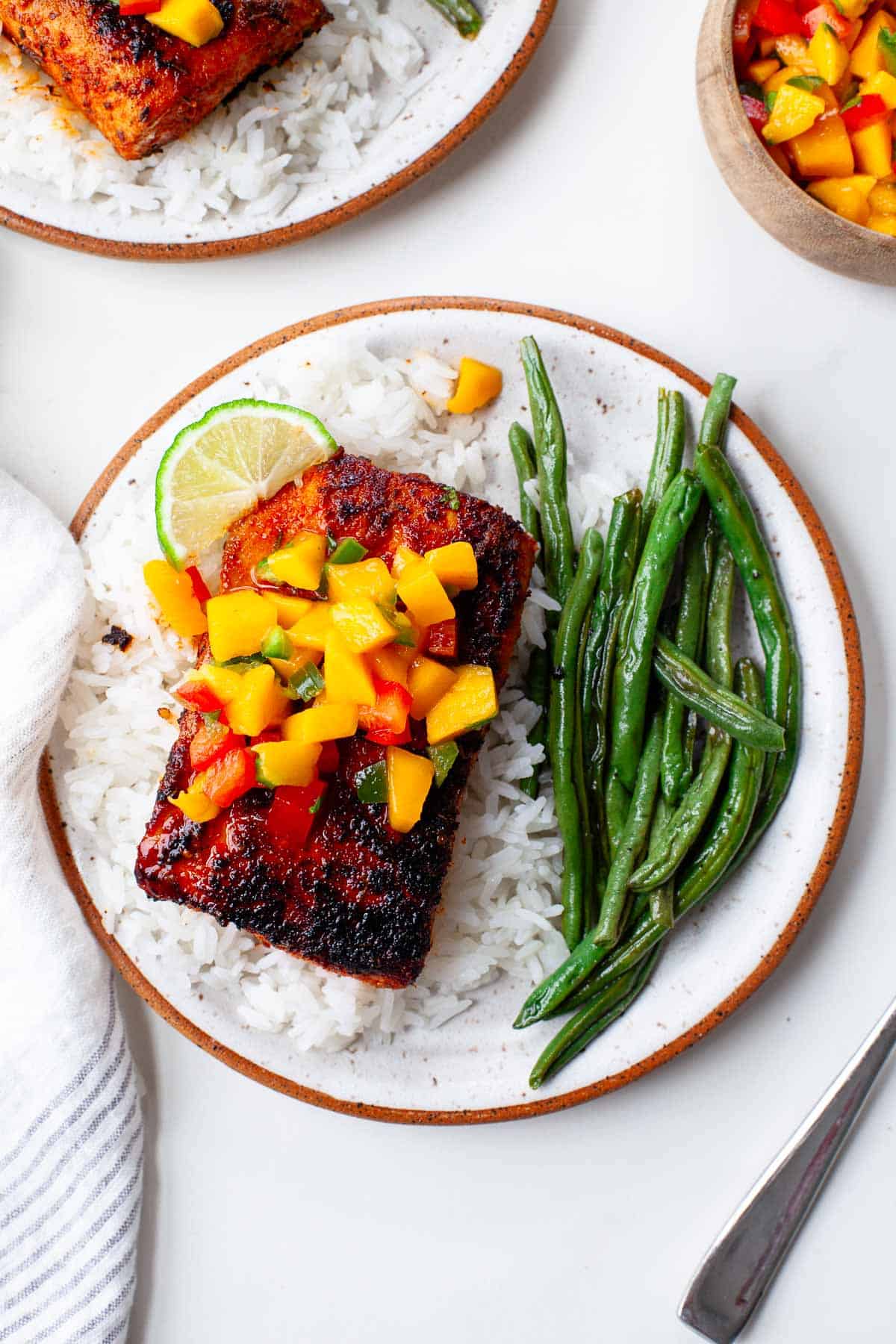
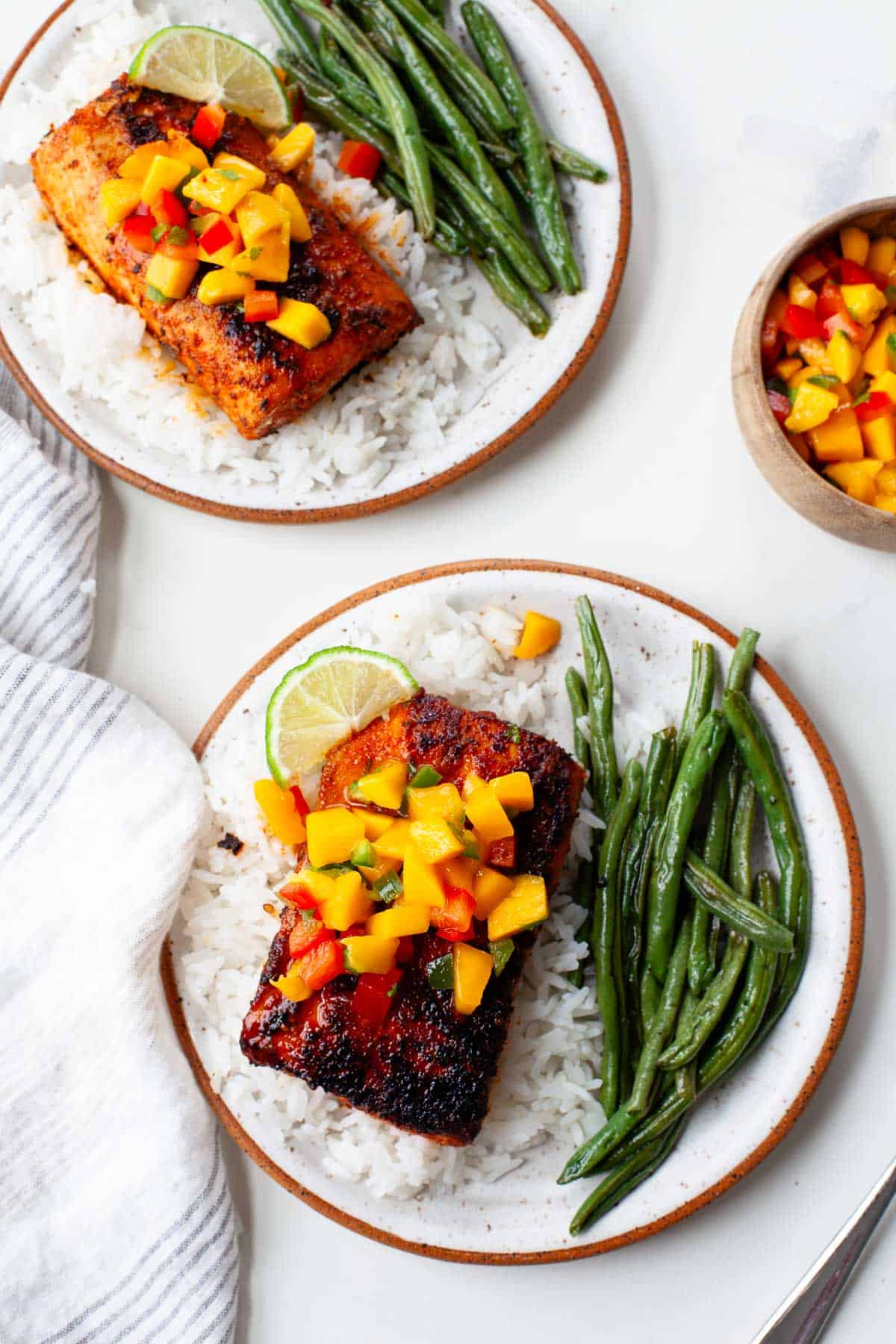
    On your table in less than 15 minutes, this blackened mahi mahi is made pan-seared with a flavorful spice rub made with spices like smoked paprika, garlic powder, and oregano.blackened mahi mahi atop a bed of white rice, garnished with fresh mango salsa and served with a side of green beans

    Why I Love This Recipe

    This blackened mahi mahi makes for a perfect weeknight dinner, coming together in just 15 minutes! While its simple enough to be added to your weeknight dinner rotation, it’s also impressive and tasty enough to serve to guests. 

    This dish is loaded with flavor. The surface of the fish takes on a crisp, almost caramelized texture and has a buttery yet spicy flavor with a both little heat and subtle sweetness. Coated in a flavorful blackening spice rub made with spices like smoked paprika, garlic powder, and oregano, it’s bold and super satisfying!

    I love serving blackened mahi over a bed of white rice, with a side of green beans, and topped with a fresh mango salsa. 

    Ingredients You’ll Need

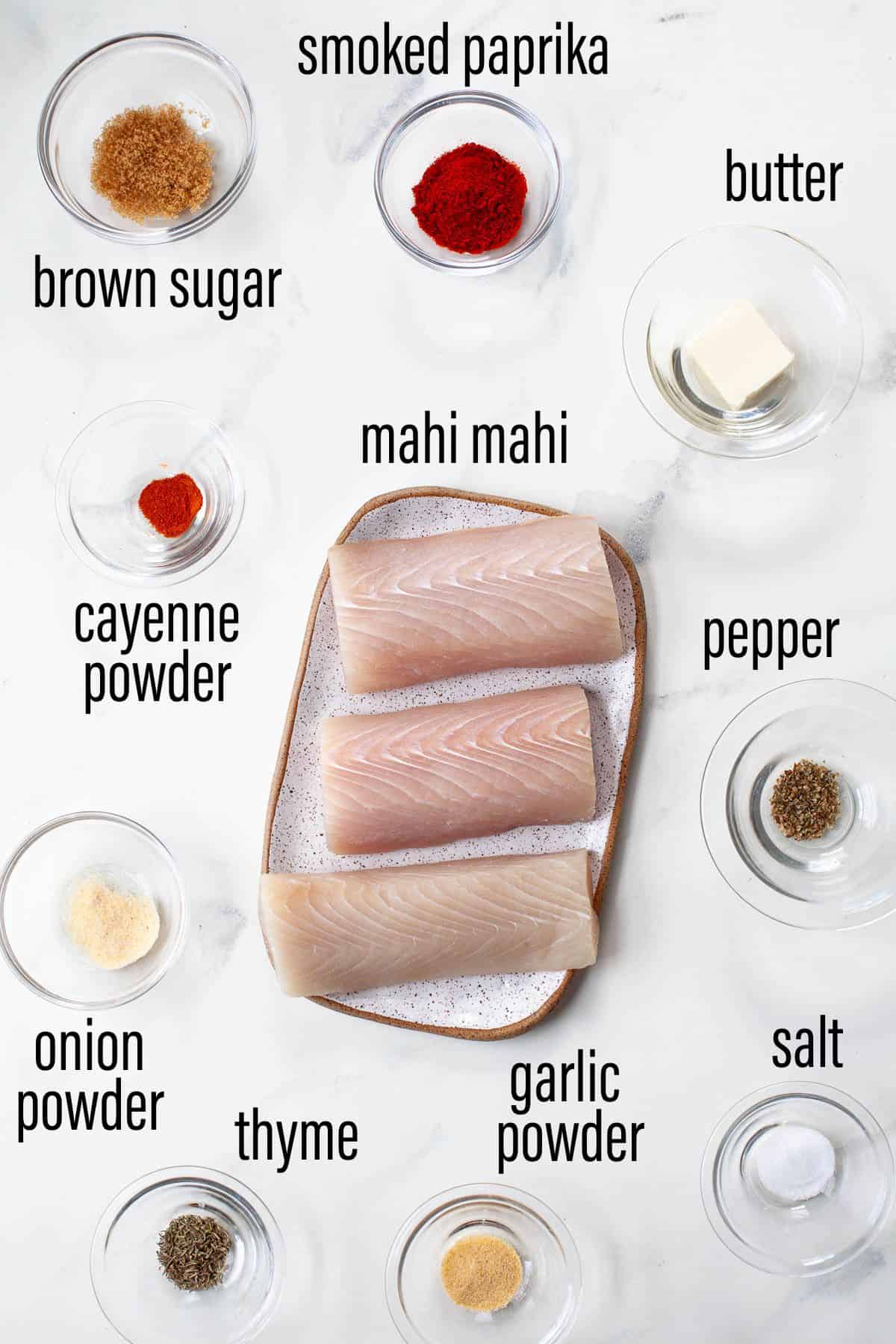
    graphic of ingredients for blackened mahi mahi on marble surface with black text overlay

    Notes on Ingredients

    mahi mahi filets: mahi mahi is a versatile, lean white fish with a slightly sweet taste and mild to moderate flavor. It’s a great source of protein, vitamins B3, B6, and B12, and omega-3 fatty acids. I find it’s most accessible when purchasing it frozen. If using frozen mahi, let it de-thaw first in the refrigerator.

    smoked paprika: adds a smoky, woodsy flavor with a little bit of sweetness

    onion & garlic powder: flavor enhancers 

    cayenne powder: provides some heat to the dish

    thyme: adds an earthy, minty, lemony flavor

    oregano: gives a bold and pungent flavor 

    brown sugar: balances the heat from spices and gives a hint of sweetness

    salt & pepper: essential flavor enhancers

    butter: used for cooking in the cast iron pan and acts as a flavor enhancer

    Equipment You’ll Need (affiliate links – if you make a purchase I receive a small commission):

    Cast iron pan

    How to Make Blackened Mahi Mahi

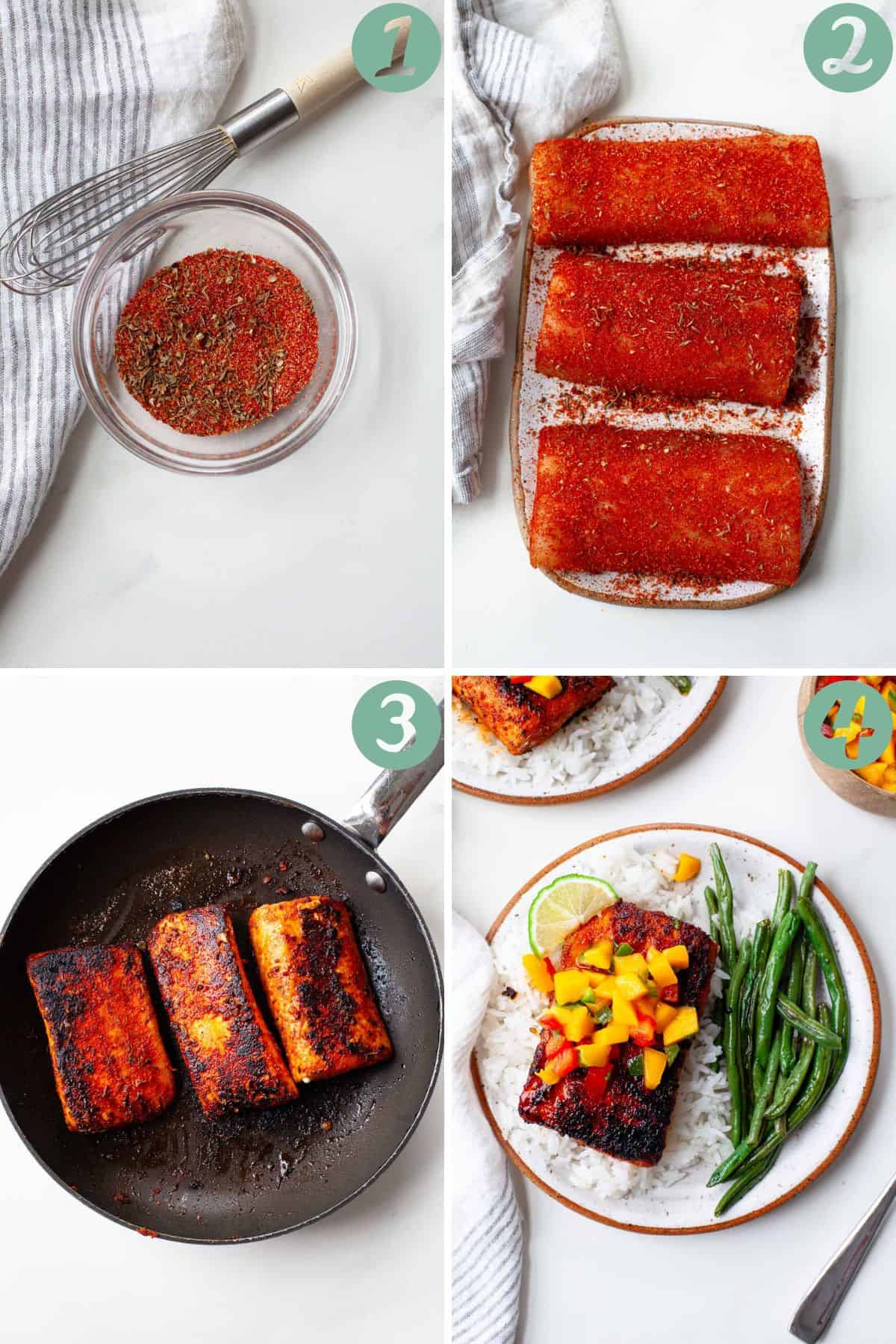
    step by step graphic of how to make blackened mahi mahi

    Combine spices. Whisk together smoked paprika, onion powder, garlic powder, thyme, oregano, cayenne powder, brown sugar, salt and pepper. 
    Season mahi filets. Pat the mahi mahi dry with paper towels then coat all sides of the filets with the spice rub. 
    Cook mahi mahi. Cook mahi undisturbed until sides are cooked just past halfway up the filets, about 3-4 minutes. Flip and cook until cooked through and flakes easily, another 2-4 minutes. 
    Serve. Serve blackened mahi mahi with rice and a fruit salsa. 

    Expert Tips

    I like to serve this mahi mahi with a fruit salsa – the sweetness and acidity are a nice contrast to the heat of the blackened seasoning. To make the mango salsa, I used:

    1 mango, diced
    1/4 red bell pepper, diced (estimate – I didn’t measure)
    1 small or 1/2 medium-large jalapeno pepper, minced
    Juice from 1/2 lime
    Salt, to taste

    Combine all the ingredients in a small bowl and adjust seasoning / spice level, as needed.

    Recipe FAQs

    What is the difference between grilled and blackened mahi mahi?

    Blackened fish is often smoky and juicy from the spices and herbs its seasoned with while grilled fish has more of a natural, charred flavor. Blackened fish tends to have more of an intense flavor from the seasonings and grilled fish usually has a simpler flavor.

    What is meant by blackened fish?

    Food that is blackened is coated in a special spice blend that takes on a very dark brown or almost black color when cooked in a skillet, on a grill, or in an oven. Blackening spices are usually a blend of a variety of spices and herbs that are traditional from both Cajun and Creole cooking. 

    Why is my mahi mahi chewy?

    If your fish has a chewy texture it’s likely because you overcooked it. When mahi mahi is overcooked it will shrink, firm up, and dry out. To prevent this from happening, I like to place the fish on a hot pan and leave it undisturbed until I can see all sides are cooked just past halfway up the filets, about 3-4 minutes. Then I flip them for another 2-4 minutes until the fish flakes easily. 

    What does mahi mahi filet taste like?

    Like many other tropical fish, mahi mahi is semi-mild and sweet tasting but not fishy. It’s similar to halibut in terms of flakiness, but also similar to swordfish in its denseness. Mahi mahi is commonly paired with citrus flavors like lime and fruit salsas. 

    blackened mahi mahi served on a specked plate with white rice, green beans, and fresh mango salsa

    Storage and Preparation

    Blackened Mahi Mahi leftovers can be stored in an airtight container in the refrigerator for up to 3-4 days.

    Recipes That Pair Well

    Summer Peach Corn Salad

    Instant Pot Asparagus

    Vegetarian Rice Pilaf

    Kohlrabi Fries (Baked or Air Fryer)

    two plates of blackened mahi mahi atop beds of white rice, garnished with fresh mango salsa and served with green beans

    For more seafood inspiration, check out my other recipes below!

    Blackened Salmon Tacos with Corn Avocado Salsa

    Spicy Seafood Stuffed Peppers

    Sheet Pan Salmon and Veggies

    Shrimp and Veggie Kabobs with Wild Blueberry Barbeque Sauce 

    Easy Shrimp Pesto Pasta with Asparagus and Sun-Dried Tomatoes

    If you like this recipe, please be sure to comment and give it a 5 star rating below. If you make it, share it on Instagram and tag me @karalydonrd and I’ll re-share it with my followers! If you want to save this recipe for later, be sure to pin it on Pinterest!

    Don’t miss a recipe! Sign up to receive my monthly newsletter with a round-up of recipes from the previous month and get my FREE guide when you sign up: Rediscover the Joy in Eating: 5 Simple Steps to Stop Stressing Over Food + Enjoy Every Bite.

    Print

    clock clock iconcutlery cutlery iconflag flag iconfolder folder iconinstagram instagram iconpinterest pinterest iconfacebook facebook iconprint print iconsquares squares iconheart heart iconheart solid heart solid icon

    Description

    On your table in less than 15 minutes, this blackened mahi mahi is made pan-seared with a flavorful spice rub made with spices like smoked paprika, garlic powder, and oregano. 

    2 1/2 teaspoons smoked paprika
    1/2 teaspoon onion powder
    1/2 teaspoon garlic powder
    1/2 teaspoon thyme
    1/2 teaspoon oregano
    1/4 teaspoon cayenne powder
    1/2 tablespoon brown sugar
     1/2 teaspoon salt
    1/8 teaspoon pepper
    2 tablespoons butter
    3, 5-6 ounce mahi mahi filets

    In a small bowl, whisk together smoked paprika, onion powder, garlic powder, thyme, oregano, cayenne powder, brown sugar, salt, and pepper, until combined.
    Pat the mahi mahi dry with paper towels.
    Season all sides of the mahi filets with the spice rub.
    In a nonstick or cast iron pan, heat butter over medium heat. Add mahi mahi and cook undisturbed until sides are cooked just past halfway up the filets, about 3-4 minutes. Flip filets, and cook until cooked through and flakes easily, another 2-4 minutes, depending on thickness.
    Serve mahi mahi with rice and a fruit salsa.

    Notes

    I love serving this blackened mahi with a mango salsa. To make, simply dice a mango, some red bell pepper and jalapeno pepper. Add squeeze from 1/2 lime and salt, to taste.

    Prep Time: 5 minutesCook Time: 8 minutesCategory: DinnerMethod: Pan SearCuisine: Cajun

    Keywords: blackened mahi mahi, blackened mahi

  • Green Chicken Enchilada Casserole (Healthy)

    Green Chicken Enchilada Casserole (Healthy)

    Green Chicken Enchilada Casserole (Healthy) – The Real Food Dietitians


    Verified by MonsterInsights

  • Skin Care In Your 60s And Beyond: Pamper And Hydrate

    Skin Care In Your 60s And Beyond: Pamper And Hydrate

    Getting older means so many great things. By the time you hit 60, you’ve learned to embrace your true self, and you have the opportunity to focus on what makes you happy. Feeling your best (inside and out) should be a priority at this stage of life — and taking care of your health and skin will go a long way toward achieving that goal. Read on to find out how to replenish and rejuvenate your skin as you move into the next phase. 

    Your Skin at 60 And Beyond

    By the time you reach your 60s, your skin has seen a lot! Between sun exposure, environmental factors, laugh lines and hormonal changes, there’s a lot of life showing up on your complexion. 

    You’ve no doubt noticed that your skin is getting dryer, thinner and more fragile these days. Irritation, redness and blotchiness may be showing up uninvited, and the texture may feel a little rough. As if that’s not enough to deal with, you’re also seeing more sagging, dark spots, crow’s feet and fine lines.

    While the “age” of your skin itself is partly to blame, time isn’t the only culprit. “Exposure to sunlight is one of the major causes of aging skin,” says the Eminence Organics Product Support Team. “It may not have been visible in the earlier years but will show up later in life. It breaks down the elastin fibers causing skin to sag, stretch and lose its ability to bounce back.” 

    We can’t undo the sun damage that’s been done, but what we can do is protect our skin and put the brakes on further deterioration. The first order of business in skin care over 60 is to wear sunscreen of SPF 30 or higher – no exceptions! That may not have been a priority (or even on your radar) back in the day, but things have changed. Lucky for you, sunscreens have changed too. There are choices galore with textures to suit every preference — creams, fluids and powders are all options, so there are no excuses. 

    Other general pieces of advice may seem self-evident, but we often forget about them: Always source high-quality skin care for aging skin (a good moisturizer will do wonders), drink lots of water, keep up with physical exercise, eat well and get plenty of sleep. Perhaps think of investing in a good humidifier which can add moisture to the air. 

    Best Skin Care Routine For Your 60s

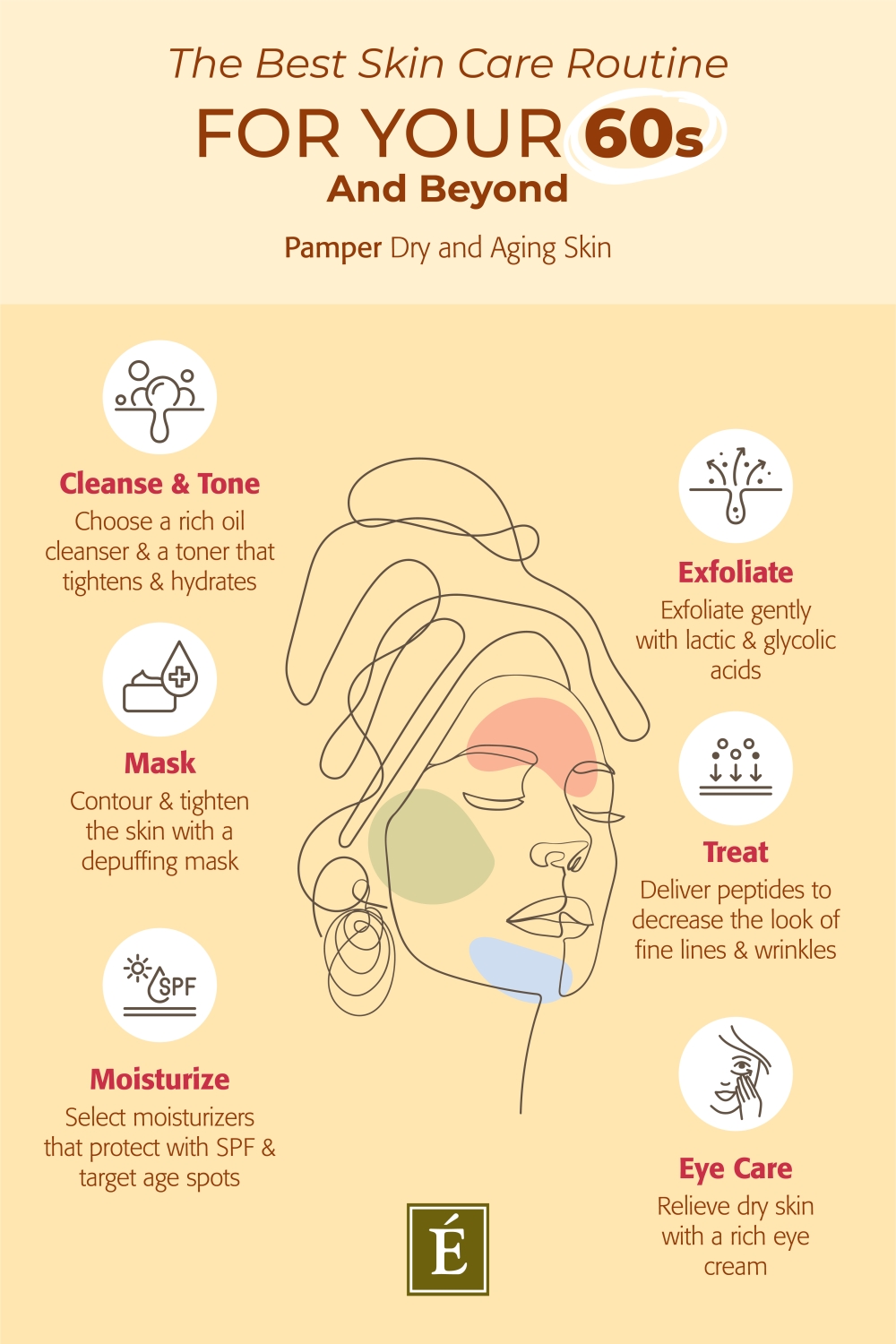
    Now that the basics are covered, what are the next steps? The key to a great skin care routine this decade and beyond is to be kind to your skin. Using luxuriously soft cloths and investing in your products will make a huge difference. Pampering is important for mature skin, so indulge in the best options you can find. Here’s what to look for when choosing skin care for dry, aging skin.

    Cleanse

    The first rule of thumb is try not to wash your face too often. The fatty acids on your skin are precious and fleeting at this stage. Over-cleansing, especially with hot rather than lukewarm water, chases those fatty acids away when you need them most, which compromises the skin’s delicate moisture barrier. When you do wash your face, try a rich oil cleanser that leaves skin hydrated and dewy. Another option is a mild exfoliating cleanser to remove surface debris and smooth the appearance of skin. The Firm Skin Acai Cleanser has antioxidant-rich acai berries that improve the look of elasticity in the skin. 

    Tone

    Toner is an essential step – not only to complete the cleansing process but also to further reduce the signs of aging with hydration. Combat the appearance of sagging skin by following up your gentle wash with a tightening and hydrating toner. For example, the Neroli Age Corrective Hydrating Mist tones the skin with a pH-balancing and nourishing combination of coconut water, neroli oil and coconut milk. One user, RMS, left a review saying: “I use this at least twice a day and my skin feels clean afterwards and hydrated. Great product for mature skin … highly recommend. Has a great smell too.”

    Exfoliate

    Use a mild chemical peel that includes lactic and glycolic acids. Regularly sloughing off dead skin cells helps with the absorption of active ingredients in products because they don’t have to battle through that extra layer sitting on top. Skipping exfoliation leaves dead skin on your complexion, making you look more dull than glowy (exacerbating the visible signs of aging). Not only does exfoliation reduce these signs, it can also firm up the skin. The Firm Skin Acai Exfoliating Peel offers cotton round pads with a peel solution sourced from grapefruit, acai berry and goji berry. The peel also includes lactic and glycolic acids (excellent options for mature complexions) to reveal smoother-looking skin. 

    Mask 

    The masking step is your secret weapon to improving the appearance of your skin. Natural and botanical ingredients, like those found in Eminence’s Snow Mushroom & Reishi Masque, help reduce puffiness while tightening the appearance of the skin. You’ll look smooth, contoured and youthful.

    Treat

    While you can’t undo the sun and environmental damage you’ve accumulated, you can take steps to treat the appearance of skin. Peptides, a key ingredient in our Marine Flower Peptide Serum, can diminish the look of fine lines and wrinkles. The Rosehip Triple C+E Firming Oil is another luxurious facial treatment containing a blend of results-oriented actives and ingredients that provide intense hydration and protection.

    Moisturize

    Now, more than ever, moisturizer is a must. Moisturize frequently, and preferably right after cleansing, to restore the skin’s moisture barrier. Some of the best face creams for over 60s skin will contain shea butter which is ideal for softening dry skin. Or try the Hibiscus Ultra Lift Neck Cream, which is formulated with hibiscus and botanical hyaluronic acid to keep skin looking firm. 

    And if the moisturizer includes SPF to prevent further sun damage, even better. The Tropical Vanilla Day Cream SPF 40 protects and revitalizes skin with vanilla, shea butter and SPF 40 all mineral protection.

    Night Cream

    Moisturizing before bed is a smart way to protect against transepidermal water loss, which is essentially water evaporating from the surface of the skin. A specialized night cream allows you to target specific skin concerns around the clock. In the morning you’ll want to protect skin from further sun damage while adding hydration, while nighttime is the perfect time to enhance your skin’s natural repair process. The Monoi Age Corrective Night Cream For Face & Neck is an overnight cream that leaves the skin appearing finer, smoother and more youthful.

    Eye Care

    Your eyes have seen a lot and it likely shows. The skin in that area is thinner and even more fragile, so a little extra love is a good idea. Give the eye area special care with rich eye cream that relieves the appearance of dry skin. The Marine Flower Peptide Eye Cream is a triple threat visibly improving the appearance of wrinkles, puffiness and dark circles.

    Cherish your skin at 60 and beyond. Taking time and care with it now will allow you to move through your mature years with beauty, grace and radiance. Learn more from an Eminence Organics Spa Partner, and find out about the availability of consultations, product recommendations, tips for skin care over 60 and in-spa treatments.

    Not in your 60s? Find skin care information for your age group: 

    This article was originally written by Clara Young in May 2020.

  • Padişahbet
    Betnano Giriş
    Crypto Casino
    new online casino
    Padişahbet Giriş
    Padişahbet Giriş
    Padişahbet Güncel Giriş