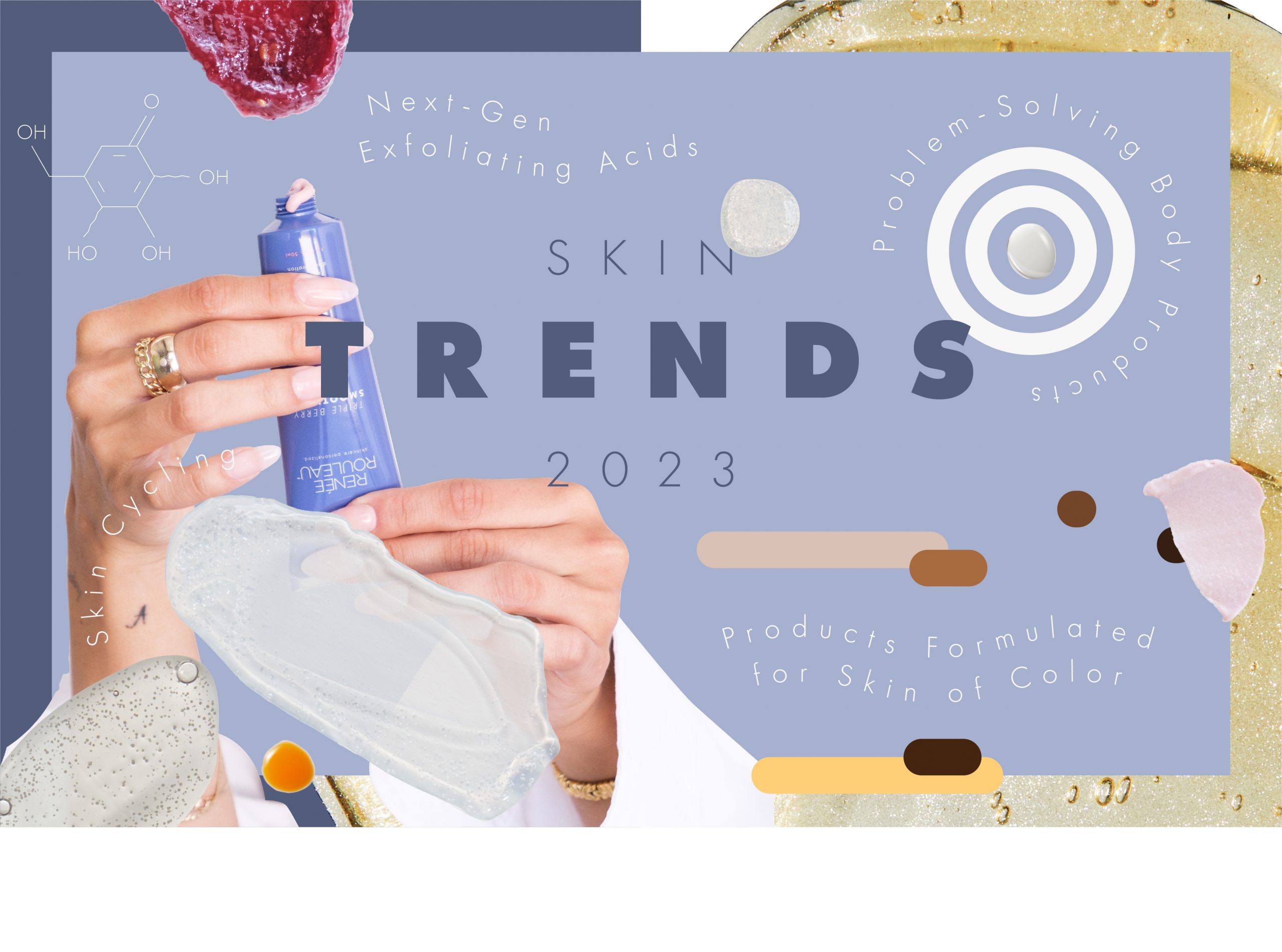
With TikTok being the main driver for many skincare trends recently, it seems they come and go in the blink of an eye. It also means information needs to be delivered in a more condensed (and visual) format than ever before, which isn’t always a breeding ground for the soundest advice. While the social media landscape can’t be discounted when it comes to trend prediction, I like to turn to my other sources as well. This includes the time I spend visiting and collaborating with some of the best skincare labs in the country. Of course, it also includes all of the wonderful industry colleagues I’m lucky to call my friends. Based on what I’ve seen this year, here are six trends I expect to take hold in 2023. There are some exciting new developments, but I think you’ll also find many of the trends going back to the basics—a balanced routine for healthy, nourished skin.
1. Skin Cycling
Skin cycling has been all over social media for a few months now, and it seems to be resonating with audiences far and wide. Putting together a comprehensive skincare routine is still confusing for a lot of people (I certainly get questions to this effect all the time), so I can understand why this trend has taken off.
The term “skin cycling” was coined by dermatologist Dr. Whitney Bowe and has amassed over 15 million hashtag views on TikTok. Boiled down, it’s essentially a guide to rotating serums in your nighttime routine. In her version, Dr. Bowe says night one is for exfoliation, night two is for a retinoid, and then nights three and four are all about hydrating and nourishing to strengthen the skin’s moisture barrier. She also notes that this is the “beginner” version. From here, there can be a number of variations depending on what your skin needs and can tolerate.
Unlike many social media trends, I’m all for skin cycling! It’s a concept I’ve been preaching for a long time. Although I’ve never called it skin cycling, I’ve always advised both clients and customers to rotate their serums rather than trying to layer a bunch of them on at once.
For someone using a retinoid in their routine, this is the “skin cycling” schedule I recommend people work up to:
Nights 1&2 — RetinolNight 3 — ExfoliationNights 4&5 — RetinolNight 6 — ExfoliationNight 7 — Hydration/Recovery
You can learn more about how to work up to this routine in my Beginner’s Guide to Retinol and Retinoids.
2. Problem-Solving Body Care Products
Skin care isn’t just about the face anymore. For years, skin experts (including myself) have been preaching the importance of including the neck and chest in your skincare routine. More recently, that’s been expanding to include the entire body.
There’s no shortage of nourishing, moisturizing body products, and this is definitely the first step to healthy skin. Going forward though, I think we’ll see more body products with active ingredients to combat targeted concerns. This especially includes humectants, like glycerin or hyaluronic acid, antioxidants, and exfoliating acids to tackle ingrowns, discoloration, acne, and bumpy skin. For better delivery, some are opting to create body serums rather than traditional lotions or creams.
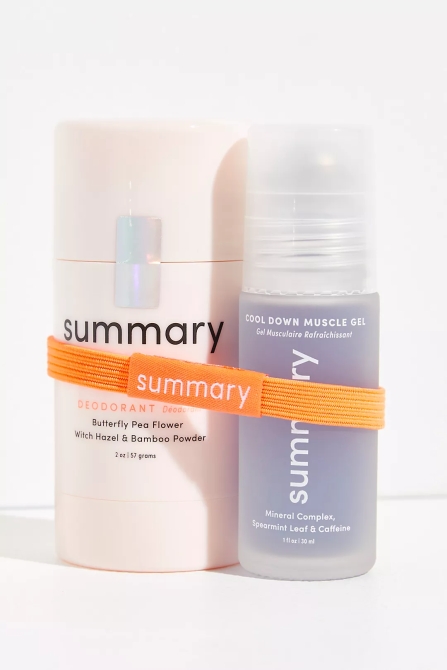
I also want to give an honorable mention to deodorant—a category that’s exploding right now. Average monthly search volume for “deodorant” and “antiperspirant” have been steadily increasing all year, and I think it’s a category of body care many brands will be expanding into. We’ll see more deodorants that include soothing ingredients traditionally seen in skin care, such as niacinamide and aloe.
Additionally, there’s been a rise in deodorants that contain alpha-hydroxy acids. This is reflected in the growing social media trend of using glycolic acid toner as a deodorant. While I don’t think this is the best idea due to the risk of irritation, it’s true that exfoliating acids can help reduce odor. If this is something you’re interested in trying, you can look for deodorants with exfoliating acids safely built into the formula.
3. A Focus on Barrier-Repairing Ingredients
Last year was the year of barrier education, and now brands are following suit by including more barrier-friendly ingredients in their formulas. Ceramides are at the top of the trend list (we’ll also start seeing them in more body care formulas).
I do want to note that, while barrier repair is a hugely important skincare concept that deserves all the recognition it’s getting, our barriers aren’t as damaged as we’re being led to believe. It’s true that we have more access to powerful ingredients than ever before, so there’s a real risk of people overdoing it. But, with all the recent awareness about barrier health, I’m finding this isn’t as rampant as it was even a few years ago. Then, factor in that products are now formulated to be much gentler than they used to be. The majority of skincare products contain some type of barrier-repairing ingredient. We’ve come a long way from the days of Sea Breeze and apricot scrubs, and our barriers are better for it!
4. Next-Gen Exfoliating Acids
Exfoliating acids are nothing new, and they’ve been contributing to smoother, glassier complexions for decades. Glycolic and lactic acid (both AHAs) and salicylic acid (a BHA) have been in the spotlight for years thanks to the wide range of concerns they’re able to tackle.
It’s human nature to want to make what’s good even better, and acids are no exception. We’re starting to see a new generation of acids being ushered in, which is exciting because they’ll be even more specialized and capable of targeting specific concerns.
Here are some of the acids I’m personally very excited about (and have even started using in my formulations):
PHAs — PHA, which stands for polyhydroxy acid, is a new class of acids altogether. Although they’ve been around for decades, they were patented until fairly recently. Now that the patent has run out, you’ll see them trickling into more and more skincare products. The benefit of PHAs is that they’re far gentler than AHAs or BHAs, and they hydrate while they exfoliate. This makes them perfect for those with sensitive skin who have struggled with exfoliation in the past.
Phytic Acid — Phytic acid is a type of AHA. It’s excellent for preventing clogged pores and also acts as an antioxidant.
Azelaic Acid (& its derivatives) — Azelaic acid isn’t “new,” per se, but it has traditionally been found in prescription topicals. It’s truly an incredible ingredient with multiple benefits, but my favorite benefit is its ability to fade hyperpigmentation (if this is something you struggle with, you know how stubborn it can be). Azelaic can be a little tricky to formulate with, so now we’re seeing that there are more derivatives (such as potassium azeloyl diglycinate) available. They play better with other ingredients and offer the same great benefits.
You can find all of these acids in the Triple Berry Smoothing Peel.
5. Products Formulated With Skin of Color in Mind
The cosmetics industry as a whole has been moving toward inclusivity, and skin care is no exception. I’m happy to say that I see this continuing well into 2023 and beyond. Specifically, we’ll start to see products formulated with the needs of skin of color in mind.
To get some insight into this, I spoke to my friend Eunice Cofie-Obeng. Eunice is the founder and chief cosmetic chemist at Nuekie, an innovative health and beauty company for people of color.
“The major gaps in skin care when it comes to skin of color have primarily been effectively addressing the common skin disorders and concerns such as post-inflammatory hyperpigmentation, razor bumps, and sun protection,” Eunice said. “You will see more products that are designed to solve these problems in skin of color. This includes serums that are results-driven and address dark spots, melasma, and anti-aging while being gentle on the skin. I expect sun care for skin of color to continue to grow with the new technology being created to eliminate the white cast.”
6. Industry Experts Debunking Misinformation
As someone who’s been sharing skincare advice since 2010, I’ve always been a huge proponent of consumer education. We have access to more information than ever, and thanks to social media that information can be disseminated at a rapid pace. I’m all for it, but it has certainly turned into a double-edged sword. It’s no secret that not every source for skincare information is reputable, and with so much misinformation swirling around, it’s hard to know what to trust.
Thankfully, I think we’re starting to see an emerging trend of skin experts getting a huge following. These experts are dedicated to putting out scientifically-backed information while also debunking incorrect (and sometimes even harmful) myths. I think this will continue to become the norm as people search for voices of clarity and reason—Dr. Bowe and skin cycling are perfect examples of this.
Personally, two of my favorite follows are Dr. Ranella Hirsch, a board-certified dermatologist, and Jen Novakovich from The Eco Well Podcast. If you’re a skincare enthusiast, I definitely recommend following them!
Celebrity Esthetician & Skincare ExpertAs an esthetician trained in cosmetic chemistry, Renée Rouleau has spent 30 years researching skin, educating her audience, and building an award-winning line of products. Her hands-on experience as an esthetician and trusted skin care expert has created a real-world solution — products that are formulated for nine different types of skin so your face will get exactly what it needs to look and feel its best. Trusted by celebrities, editors, bloggers, and skincare obsessives around the globe, her vast real-world knowledge and constant research are why Marie Claire calls her “the most passionate skin practitioner we know.”